

INSIGHTS BLOG
Providing insightful, thought provoking
&
ultimately useful information

PFD Group: Empathy is the Most Important Leadership Skill
Empathy has been an important skill set for effective leaders since well before 2022, with plenty of research and studies to back that up. At PFD Group, we know that when we take the time to really understand our team, they feel more seen and they become happier and more productive.
In late March, inspired by an article posted at Forbes.com, business publications started publishing pieces on how Empathy is the Most Important Leadership Skill in 2022.
Empathy in Leadership is Not a Trend
Empathy has been an important skill set for effective leaders since well before 2022, with plenty of research and studies to back that up. The topic is such an important one that even the World Economic Forum reported on it, highlighting a 2021 study conducted by not-for-profit organization Catalyst, which advocates for more women in leadership positions.
Catalyst surveyed nearly 900 US employees during the COVID19 pandemic and found significantly more engagement by employees who work with empathic senior leaders.
76% of people with highly empathic senior leaders reported always or often feeling engaged at work. Conversely, only 32% of people who work with less empathic senior leaders feel engaged at work.
Benefits of Empathy
Engaged employees are important employees because they are consistently more productive and more efficient and they have a higher retention rate.
A lack of empathy in leadership is at least partially responsible for driving the record number of people leaving their jobs in the post-COVID era, according to noted professional services company Ernst & Young Americas. The EY study found that 41% of survey respondents look for an empathetic leader to be open and transparent.
What is Empathy?
Catalyst calls empathy the “skill of (1) connecting with others to identify and understand their thoughts, perspectives, and emotions; and (2) demonstrating that understanding with intention, care, and concern. An empathic leader is a leader who demonstrates care, concern, and understanding for employees’ life circumstances.”
Core Clarity
At PFD Group, we know that when we take the time to really understand our team, they feel more seen and they become happier and more productive. Coaching with empathy means focusing more on team player strengths and less on their weaknesses. After all, no one wants to work in a place where they're constantly being reminded of their weaknesses.
To help identify our team strengths, we use Core Clarity, a training program based on the CliftonStrengths assessment, which helps people clarify who they are at their core so they can be their best selves at home and at work.
When individuals are equipped with the tools they need to operate at their best, teams are transformed.
The assessment categorizes each individual against 34 characteristics. A resulting report provides employers with insights on each employee’s top five strengths and how each person can best contribute according to those strengths.
Looking at a catalog of CliftonStrengths assessments across all team members can also help leadership identify where the company weaknesses are. If too many employees fall into the “executing” category, then we may need to focus on hiring people in the “strategic building” category.
There are other assessments, like the Myers-Briggs assessment, but we find Core Clarity best focuses on the strengths that make people more productive.
The Personal Touch
For us, the assessment is just a start to leading with empathy because it helps us understand our employees’ strengths and talents. Being an empathetic leader means that we get to know what drives each individual on a personal level and we work with that information to help employees fulfill their potential.
One method we recommend is having each employee build a vision board. It reminds everyone of their “North Star” or the path to their personal goals.
And yes, building a vision board is a company-wide exercise. See below the Vision Board of our CEO Ethan Martin, who emphasizes the great outdoors and lots of activity in his vision.

Having a vision board helps provide guidance for everyone, even when we get distracted or lose our motivation due to events beyond our control. And many times, especially in mission-driven organizations, each person’s North Star relates to how they wish to be fulfilled by work.
In addition to the Vision Board, we also encourage our team members to develop a one-page personal plan. For inspiration on getting started, you can download our free Legacy Vision Tool.
Finally, we ensure that we make the time to have meaningful one-on-one conversations with our team members-. These checkins aren’t always in a formalized meeting setting, but they give us the time and the space to talk about what drives us. Which gives our leadership better insights on how we can coach our employees.
If you’re looking to build a more empathic leadership style, PFD Group can help! Contact us now for more information or to set up an exploratory call.

Adopting a Coaching Leadership Style
Why build a leadership team based upon a coaching-style leadership? For one, coaching opens up a two-way dialog that can lead to healthy, constructive feedback. Adopting a coaching leadership style encourages employees to learn, which allows them to have the breathing room to explore shifts in the business environment. In an organization focused on coaching, consistent and regular feedback schedule should provide employees with a comfort zone that allows them to discuss what they need to contribute, including a possible performance shift from their supervisor, allowing both employee and supervisor to grow from the experience.
The average NFL football team had a franchise worth more than $3 billion dollars in 2020. With so much riding on performance, it’s hardly surprising that each team employs an average of 15 coaches.
“The best coaches in football are constantly thinking about how to help their players get better. They focus on understanding the people on their teams, what motivates and drives them, and how best to coach them.”
–Damian Vaugh, former NFL Player, Cincinnati Bengals
This proven effectiveness of NFL coaching leads to a common question among business thought leaders. Why don’t more executives take a page out of the NFL playbook and adopt their own coaching-style leadership?
The Association for Talent Development (ATD) hypothesizes that there are four main reasons why organizational leaders don’t coach, including wanting to avoid confrontation, lack of experience in coaching, insecurity about possible insights, and lack of time.
And yet, says ATD, a coaching-style leader can encourage employees to “chase those big projects.”
Healthy Feedback
Why build a leadership team based upon a coaching-style leadership? For one, coaching opens up a two-way dialog that can lead to healthy, constructive feedback.
In business circles, a lot of attention is paid to the value of “constructive criticism” in guiding employees. At its core, however, constructive criticism is still criticism, which can be detrimental to performance and to motivation.
The alternative is providing healthy feedback.
For leaders confused between the difference between constructive criticism and feedback, Benedictine University has developed a useful infographic delineating the differences. One of the main differentiators between the two is that criticism says “you are the problem” while feedback says “we can make this better, together.”
Both methods allow for a course correction, especially when poor performance issues or decisions need to be addressed, or core values have been violated, but healthy feedback reduces the emphasis on “blame” or “fault,” especially when it is an employee’s first such experience.
Highlighting this team approach can open up your employees, especially your A Players, to be more innovative and to pursue problem-solving. Avoiding criticism can further help divest employees of the anxiety that they are considered “the problem” when ideas don’t pan out.
Creates a Learning Environment
Just as with an NFL team, a coaching-style leader encourages learning.
The past five years have been challenging for consumers. A global pandemic, a major international political conflict, growing fuel and interest rates, massive shifts in the business work environment, and major advances in technology, have all kept consumers on their toes. Not unexpectedly their buying habits have shifted tremendously during this period and will continue to do so in the foreseeable future.
There is no one organization or one person who can stay on top of these shifts and fully predict what will be the next motivator to drive consumers. To keep up, your business will need to be nimble and need to experiment, to stay abreast of what customers want and how they want it delivered.
Adopting a coaching leadership style encourages employees to learn, which allows them to have the breathing room to explore shifts in the business environment.
Building a learning environment will further help define who your A PLayers are. Employees who are consistently tied to the status quo, or tied to the “we’ve always done it this way” sentiment may not be best suited to an organization focused on growth, and may not be an A Player for your team.
Feedback Schedule
One commonality among A Players is that they usually crave feedback. They want to excel at their job and they want the tools to be able to grow. By providing regular feedback, leaders encourage employees to pursue personal and professional growth, which can cycle back greater contributions to the business.
Generally, feedback has become synonymous with the annual performance review. This once-a-year meeting is often dreaded by employees and supervisors and has been proven to be time consuming and basically ineffective as supervisors often use the platform to rehash months-old grievances rather than providing a future-facing plan for success.
What’s more, employees crave more frequent and consistent feedback. A Price Waterhouse Coopers (PWC) survey found that 60% of employees want feedback on a daily or weekly basis. For employees under 32, that number jumps to 72%.
In a coaching-style organization, the review process is best scheduled on a more frequent timeline, generally quarterly. Here, the leadership, whether it is CEO to executive team or executive team to departmental leaders or manager to employees, has a regular and routine process in place to review high-level business and departmental metrics, goals and priorities.
A regular feedback schedule also provides an opportunity to review the business’ core values and how team members are aligning their behaviors and beliefs with those core values. If the team’s values includes a commitment to on-time performance, for example, the quarterly review would be the place to discuss an employee’s tendency to show up five minutes late to all meetings and activities.
Feedback in the Moment
While a scheduled quarterly review is important in reviewing and emphasizing larger corporate metrics, in-the-moment feedback is also essential.
As noted, employees are seeking regular and timely feedback. What’s more, leaders shouldn’t allow employees to keep doing something that isn’t essential to corporate success by delaying feedback.. Additionally delaying feedback waters down the feedback as the delay can cause employees to question the value of the feedback. “If this were critical, why didn’t someone say something earlier?
Again, feedback should not be confused with criticism and as such it also means acknowledging and celebrating wins. Celebrating accomplishments not only brings people together but it also encourages employees to chase the wins.
Coaching Goes Both Ways
Building a future-facing team means providing the team with the tools they need to face the future, including the freedom to coach their leaders.
In some annual performance review scenarios, employees are able to provide a review of their supervisor. In organizations where this process exists, a fear of retribution may cause employees to avoid this step or to not complete the review in a wholly honest way. Often a funnel is created that drives employee feedback to human resources rather than directly to the supervisor.
In an organization focused on coaching, the consistent and regular feedback schedule should provide employees with a comfort zone that allows them to discuss what they need to contribute, including a possible performance shift from their supervisor, allowing both employee and supervisor to grow from the experience.
If you’d like to learn more about developing a successful coaching leadership style, PFD Group would love to support you and your senior team. Please reach out to us to schedule a call.
Topgrading Your Way to Better Employees
When it comes to building a successful high-growth business, even the most detailed business plan can be derailed by hiring the wrong employees to carry out the corporate vision. In fact, the estimated cost of a mishire can be 5 to 27 times the amount of the employee’s salary, according to Topgrading.com. Not only are there hard costs involved in hiring and firing employees, but mishired personnel can also cause a ripple effect by lowering morale and hampering sales and performance results. A really bad hire can even cause A-level employees to leave your business in search of better opportunities.
When it comes to building a successful high-growth business, even the most detailed business plan can be derailed by hiring the wrong employees to carry out the corporate vision.
In fact, the estimated cost of a mishire can be 5 to 27 times the amount of the employee’s salary, according to Topgrading.com. Not only are there hard costs involved in hiring and firing employees, but mishired personnel can also cause a ripple effect by lowering morale and hampering sales and performance results. A really bad hire can even cause A-level employees to leave your business in search of better opportunities.
When building a strong business foundation, building a strong human resource and recruitment plan is one the most important tasks facing executives.
The Topgrading Method
To reduce the possibility of a mishire, following a rigorous hiring process can significantly reduce the chances of the rate of mishired employees. One such method, the Topgrading Method, is a rigorous 12-step process that improves “the productivity, profitability, and progress of an organization by recruiting, hiring, and developing teams of top performers.
Using the Topgrading Method, the American Heart Association improved its rate of promoting A Players into upper management positions from 25 to 95 percent according to this study. As a result, the organization was able to raise $50 million more for their programs in a single year.
Rigorous Hiring Process
Even if you do not utilize the Topgrading Method, we recommend you put into place a rigorous hiring process that allows you to hire slowly and carefully consider potential employees and to fire quickly when employees who don’t match your corporate culture.
Over the years, we have seen our clients realize a significant difference in the caliber of their executive team when they adopt a careful hiring method–whether they use the Topgrading method or an alternative but similar hiring protocol.
It is especially important to use rigorous methods when building or growing your executive leadership team, as these employees tend to have the biggest influence on the entire company culture and as such must be carefully screened and hand selected.
Team members who work for a misaligned leader may do more harm than just leaving the company. They might also start venting their frustrations on public review websites or social media, which could do irreparable harm to the company and also cause confusion or decrease loyalty among potential customers reading these social media posts.
Carefully hiring your executive team can benefit your company in many ways, across all levels. It can increase morale among employees as it drives home the message that you care about them and that you are making the effort to hire leaders that are the right fit. Your employees will feel less stress and experience better communication as they work with leaders that guide them and help them lighten their load.
Be sure to incorporate employee feedback in the hiring process. If your team didn’t work well with a previous manager because of micromanagement issues, for example, be sure to address that in the next round of hiring, it will show you listen to your employees and you care about their feedback.

What goes into planning an event with purpose?
People are yearning for connection in these unpredictable times, and as you continue to lead your business, we wanted to share some best practices that we use for planning events with purpose. Before beginning the process of planning an event, it is crucial to understand the motivation behind it. Having a clear vision for the purpose of your event is the foundation of a successful experience for the hosts, vendors, and attendees.
When our team went to Alaska to meet with potential caterers and vendors for our Stewardship Summit event this summer, we got the chance to build meaningful relationships with great leaders who are dedicated to serving others. In our experience, we find that meeting in person to discuss our events is the best way to understand if potential partners share our vision, create a collaborative planning process, and solidify the purpose of the event.
People are yearning for connection in these unpredictable times, and as you continue to lead your business, we wanted to share some best practices that we use for planning events with purpose.
Determine the primary focus, goals, and priorities for your event
Before beginning the process of planning an event, it is crucial to understand the motivation behind it. Having a clear vision for the purpose of your event is the foundation of a successful experience for the hosts, vendors, and attendees. Making sure your team shares this vision is just as important. The more time leaders spend on collaborating with their team to develop a clear vision, the better they can navigate daily tasks and decisions.
Some helpful guidelines that we use to jumpstart the event planning process include brainstorming the following questions:
Why does the event matter? or What is the purpose of the event?
What does success mean and look like for the event?
What are the top three desired outcomes of the event?
What is the long-term value of the event?
Mapping out these questions helps us define the purpose and legacy of our events. When your team is on the same page regarding the mission of the event, they will innately be more invested in the planning and execution journey.
Selecting attendees that share your core values
One of the more creative ways that we like to plan our events is by thinking about who our ideal attendees might be. Identifying the right core value fit for your attendees will help you create a unique and valuable learning experience that is cohesive across all event participants.
A fun strategy that helps us select our desired attendees is asking your team to pick a group of people (dead, alive, or fictional) that they would want to attend the event. This exercise is a great way to define criteria for potential candidates.
Start out by listing the top 10-25 people you would most like to attend and transform the event.
Identify positive and relevant characteristics that stand out.
Use this information to develop various criteria for your ideal attendees and build the event around them.
Everybody is different, and it is important to keep in mind that while some attendees may be excited to participate in special activities, others may prefer to engage in something else. However, we can’t be everything to everyone, so selecting attendees that share your core values and share the same interests is key to providing a well-rounded experience. Being selective can be scary, but we encourage it.
While the foundation of any event starts with purpose and people, we know that there are many other details to consider when putting together your event. If are interested in a detailed event planning checklist, click the button below to access a free tool that we use to create the best experience for our clients.
Building strong relationships with vendors
We highly recommend building strong relationships with the people who are a part of your event. Get to know if potential vendors share the same core values and are a good fit by meeting with them in person or planning a fun activity together.
In addition, we strongly suggest giving vendors, caterers, and other key staff members a say in the development of the event planning process. Making discussions open-ended and asking questions will establish a collaborative space where hosts and stakeholders can co-create.
For the last couple of weeks, we have been working on building connections with potential vendors and caterers for our Stewardship Summit in Alaska this year via phone and email. Before meeting these potential partners in person, we had preconceived ideas of them. When we met everybody in person, our expectations and perceptions changed; some vendors exceeded our expectations, while others fell short. Having these in-person introductions allowed us to evaluate their business setup, how they run their company, and how they incorporate creativity into their work. Without having meant with these vendors in person, it would have been difficult to identify the best fit vendors and build relationships with them.
If potential vendors have a vision that reflects your mission and coincides with your desired outcomes, this is a good sign that they are the right fit for your event.
When we develop a clear vision, determine who is the right core value fit to attend, and build close relationships with potential vendors, it becomes much easier to navigate planning events with purpose. We find collaboration and co-creation to be essential tools for providing a positive and valuable experience for everyone, and hope these strategies guide you through the event planning process.

The Importance of a Peer Community
In times of great stress or in times of great success, executive-level decision making can feel more weighty than it does when business operations are running “as normal.” In difficult times, an ill-advised choice could jeopardize jobs or even an entire business. In times of surplus, executives may find themselves making decisions based upon the temporary high fueled by success-generated endorphins.
In times of great stress or in times of great success, executive-level decision making can feel more weighty than it does when business operations are running “as normal.” In difficult times, an ill-advised choice could jeopardize jobs or even an entire business. In times of surplus, executives may find themselves making decisions based upon the temporary high fueled by success-generated endorphins.
It is a natural human instinct to allow sentiment to inform important choices–the expression, what was I thinking? has become a cliche for a reason.
Executive decisions must be informed by real world metrics and that can be undermined when emotions are running high. Which is one of many reasons why having a strong peer community is so important for executives.
If you’re looking to join or build your own peer group, here are a few recommendations to help get you started.
Understand What a Peer Group Is
At its core a peer group (also called a cohort or peer network) is a “group of people who share the same experiences to mentor one another.” It is important to note that finding a peer group (networking) is not the same as nor does it drive the same benefits as actually belonging to a peer network.
“We need to recognise that there is a huge difference between networking (the verb) and a network (the noun).”
–James Millar, author of “Building Bridges: The Case for Executive Peer Networks.” (via The Economist)
Find a Group That Will Keep You Accountable
When establishing or joining a peer group, it is essential to find a group with leaders who not only advise their peers but who also back up their advice with real-world examples. These are the leaders who help the group build a culture of accountability.
If leaders engender a sense of accountability, they will expect the same from you. Over time, your foundation of accountability will also ripple down to your A-players, causing them to also foster a similar environment for their team members and to reciprocate that accountability back to you.
Find a Peer Group that Will Help You Learn
A strong peer network will encourage you to learn more about your business and about doing business in general. Not only will the group set examples for you to explore, but their habits and practices will encourage you to set into motion reciprocity that will allow you to contribute your own learnings back to the group.
Join a Peer Group to Match Your Field/Position/Relatables
While learning is good, too much learning might be a distraction from strengthening your business. Finding your group of peers could mean teaming up with other executives, of all levels, from within your industry or joining a group of leaders with similar executive responsibilities, but representing a variety of industries.
Your peer group could even be made up of a group of executives with similarly aligned missions. No matter how the relatables align, be sure to find a group that offers a robust dialog and a space for problem-solving
At PFD Group, our CEO Growth Forum–a group of mission-driven CEOs–is designed to help executives to build a community, to find confidence and clarity in their leadership abilities, and to develop a strong execution plan and implementation strategy.
Join a Peer Group With Differences
While a group aligned over their similarities can lead to better problem solving, there’s also a case to be made for joining a peer group with viewpoints and backgrounds that are different from your own. If everyone is used to thinking the same way or following the same direction, that may not lead to room for creativity.
The benefits of diverse corporate environments has been well-documented by the Wall Street Journal. In a 2019 article entitled, The Business Case for More Diversity, the Wall Street found that the 20 most-diverse S&P companies performed better financially over five- and ten-year periods.
Finding a group that can visualize success from a different perspective allows you the freedom to explore ideas on new levels.
Find a Community of People Who Want to Be a Part of Something Bigger
Yes, your business is important. And yes, earning a comfortable (or better) living is important. But growing a healthy business means starting with a healthy life balance.
What “something bigger” means to you and to your business can only be answered by you. But it is also why your business’ core values are so important. They not only guide how the business will perform but they should also guide the living principles and values of the business leadership.
The PFD manifesto has three elements: our Core Values, our Core Purpose, and our BHAG. Our core purpose, “to steward lives” is not just a written statement built to appeal to potential clients.
Last year PFD Group gathered a group of clients and partners at our Stewardship Summit in Alaska. We spent the week discussing how we could use our businesses as a force for good while also building our peer community and crafting multigenerational philanthropy tied to business and family. All while spending time in the great outdoors and recharging and relaxing at Meier Lake. Spouses also attended, inviting them into the inner workings of peer community building.

Stewardship Summit Closing Day 2021
We are finalizing the planning for this year’s summit, which will be held at Meier Lake, Wasilla Alaska, August 2-6. If you’re interested in giving back while building your peer network, please book a call to learn more about joining us in Alaska.
How Core Values Guide Your Company Culture
The concept of corporate culture has been a hot topic among executives since long before the onset of the global pandemic. When Jeff Weiner, the former CEO of LinkedIn who was once named Entrepreneur of the Year, first joined LinkedIn, he met with his leadership team to discuss exactly what corporate culture would look like for the social media giant.
The concept of corporate culture has been a hot topic among executives since long before the onset of the global pandemic. When Jeff Weiner, the former CEO of LinkedIn who was once named Entrepreneur of the Year, first joined LinkedIn, he met with his leadership team to discuss exactly what corporate culture would look like for the social media giant.
“I sat down with the leadership team, and we started talking about the kind of organization we wanted to be a part of and what kind of personality we collectively believe that the company should be manifesting and espousing.” – Jeff Weiner, former CEO, LinkedIn
While creating a well-defined corporate culture is certainly important in building a strong business, the pandemic has also demonstrated that the sands beneath a corporate culture are constantly shifting. New speed bumps will always line the road ahead and affect how corporate culture plays out, both in the short term and in the longer run.
Although corporate culture may be ever-shifting, it can still provide a strong direction for the business as long as that culture is guided by the company’s Core Values.
These non-changing values ask the question: “What are the consistent, accepted behaviors of your team members?” and are one of the most important drivers of a successful team.
At PFD Group, our company culture is guided by a central manifesto that consists of three main elements, our Core Values, our Core Purpose, and our BHAG (Big Hairy Audacious Goals.)
Before all else, our Core Values – grow to give, create value, communicate proactively, invest in our team and community, and be the confidant–drive everything we do and inform how we communicate to the world. They remain unchangeable no matter what challenges face us on any given day.
The Importance of Actively, Specifically Living Out the Core Values
Are Core Values really that important?
History is full of companies not exemplifying their Core Values. Wells Fargo listed “ethics” among its Core Values while employees created thousands of fake accounts. United Airlines, whose flight crew famously dragged a bloodied passenger off a plane, listed “we fly friendly” among its Core Values.
This disconnect between Core Values and employee actions isn’t that uncommon. A recent MIT Sloan Management Review study found “there is no correlation between the cultural values a company emphasizes in its published statements and how well the company lives up to those values in the eyes of employees. “
Core Values do matter says the study. It is just a matter of closing the gap between “official values and cultural reality.”
“As a first step, leaders can communicate corporate values more effectively by providing concrete guidance on desired behavior, ensuring their organizational values are distinctive, and linking them to outcomes that matter to employees.” –MIT Sloan Management Review
It isn’t that Core Values are unimportant, but rather that they are useless if the CEO isn’t actively engaged in exemplifying these values and creating a space where employees can safely live out these values as well.
“Culture is a thousand things, a thousand times. It’s living the core values when you hire; when you write an email; when you are working on a project; when you are walking in the hall. We have the power, by living the values, to build the culture.”
– Brian Chesky, CEO, Airbnb
Ensuring employees are aware of–and fit–the company’s values requires leaders to consistently live their Core Values and to regularly communicate them to employees.
Core Values Should Serve as a Magnet for Recruiting
Once a business has activated its set of well-defined Core Values, these values can serve as an excellent recruitment tool, especially in these modern times when employees are seeking greater personal fulfillment from their employment.
An Edelman study calls this new type of employee, “belief-driven employees who are motivated not just by salaries and benefits, but also social impact and personal values.”
“The Employee Value Proposition (EVP) now looks like a tripod, balanced on the traditional enticements of pay and career advancement, a newer focus on employee well-being, with flexible hours and remote work, and now an employer commitment to act for good on society’s biggest challenges. Employers must stand up every leg of this tripod if they want to win and retain the activated employee.”
The Edelman study found people are increasingly selecting work options that align with their personal beliefs. Six in 10 of the people studied said they “choose, leave, avoid or consider employers based upon their values and beliefs.”
With up to 60 percent of the workforce now seeking employment that fulfills their personal values, companies with strong Core Values stand to attract the best of the best among these belief-driven employees.
Coach for Performance, Not For Core Values
In a previous article on our site, The Ethics of Hiring Well, we detailed the importance of hiring people to match your organization's Core Values. In the words of Verne Harnish, author of Scaling Up, hiring well boils down to one important question: “Would you enthusiastically rehire everyone knowing what you know today?”
Hiring and retaining these A-Level employees can save frustration on the part of the supervisor and the employee when it comes to coaching the employee’s performance, as it requires less emphasis on encouraging the employee to “change their behavior.”
Change isn’t easy, and behavior change will almost never come about in response to a performance review. “...change must start with a deep, personal, intrinsic motivator. A company cannot educate behavior change,” said Lowinn Kibbey, global head of the Johnson & Johnson Human Performance Institute.
When the behavior is already aligned with the company values, it leaves the employee the space to focus on their performance metrics and allows the supervisor to focus on measuring performance, rather than trying to fix bad behavior. The alignment also provides employees with a workplace that allows them to thrive.
Finding and hiring employees who are already aligned to the company’s Core Values means supervisors can focus on measuring performance against company-set performance metrics.
If you’d like to learn more about aligning your business Core Values with your hiring principles, we would love to support you and your senior team. Please reach out to us to schedule a call.
The Importance of Effective Communication
At the PFD Group, effective communication is one of our core values and we also recommend it as a key success driver for our high-growth clients.
But what is effective communication?
We find many CEOs theoretically understand the importance of great communication both internally and externally, but they sometimes flounder when it comes to execution.
If you read any blog about business management, you’ll likely see effective communication listed as a must-have technique. Communication is so important to company culture, one study measured the cost of poor communication at $62.4 million per company per year for businesses with 100,000 or more employees.
That’s an expensive misstep.
At the PFD Group, effective communication is one of our core values and we also recommend it as a key success driver for our high-growth clients.
But what is effective communication?
We find many CEOs theoretically understand the importance of great communication both internally and externally, but they sometimes flounder when it comes to execution.
To borrow the words of Irish playwright George Bernard Shaw,
“The single biggest problem with communication is the illusion that it has taken place.”
The Importance of Repetition
When it comes to team communications, CEOs can especially undervalue the importance of repetition.
How often have we heard the phrase “don’t make me repeat myself?” Inherent in the statement is the assumption that repetition is a nuisance or a waste of the CEO's time.
The advertising industry has no such concerns with repetition.
If you can finish this statement, “I wish I were an Oscar Meyer…”, your brain already understands the importance of repetition.
The popular hot dog jingle was first released 60 years ago and it ran so repeatedly for nearly 50 years, that most people can still recount the joys of being an Oscar Meyer wiener a decade after the commercial last aired.
Understanding that commercial enterprises spend billions of dollars to build brand awareness and to keep their messages top of mind, also means it shouldn’t be impossible for team leaders to take a page from the advertising playbook.
Great Leaders Encourage Repetition
Jeff Weiner, CEO of Linkedin, who has been rated one of the best CEOs to work with has stressed the importance of repetition. In a recent Business Insider interview on effective leadership techniques, he says
“A friend of mine once paraphrased David Gergen, saying on the subject of repetition, ‘If you want to get your point across, especially to a broader audience, you need to repeat yourself so often, you get sick of hearing yourself say it. And only then will people begin to internalize what you're saying.‘“
The Science Behind Retention
Science has proven that people hear and retain things differently.
In one example, researchers at Canada’s University of Waterloo have illustrated the “forgetting curve,” to show the importance of repetition when it comes to studying for midterms.
“When you are exposed to the same information repeatedly, it takes less and less time to ‘activate’ the information in your long-term memory and it becomes easier for you to retrieve the information when you need it.”
According to the chart, If your brain does nothing with the information it receives, by day two it will have forgotten 50% to 80% of the information it has received. The key takeaway here is the importance of communicating regularly with your team.
Regular Communications Through Regular Meetings
At PFD Group, our main communications occur through two regularly scheduled meetings: our daily huddle, and our longer weekly meeting.
For a daily huddle, we recommend a check-in that lasts no more than 15 minutes and sticks only to relevant topics. Our agenda generally includes highlighting good news, providing a metrics update, and sharing lessons learned. We close out the huddle by discussing the most important item for the day, with a specific plan for what success looks like at the end of the day.
Our weekly meeting is usually scheduled for 60-90 minutes and follows a similar agenda as the daily huddle, but with the addition of top action items and a list of three priorities for the coming week. The agenda also incorporates a review of company priorities. Here the team has the opportunity to process and re-process information every week, keeping our company priorities well ahead of the “forgetting curve.”
Our weekly meetings also help build accountability, because they encourage the entire team to participate in the communication process, especially when it comes to solution building.
The Weekly CEO Letter
To further emphasize company priorities, we also reiterate them in a written format through a weekly CEO email. The information in the email is compiled by our entire senior leadership team but is edited by our CEO and sent to the entire company from his email on a set schedule every week. In it, we celebrate our wins, reinforce our core values, and share our KPIs.
By regularly sharing our core values and KPIs through in-person emails and written communications, we ensure plenty of repetition for all employees, allowing for flexibility in each individual learning process.
If you’re looking to develop better communications, we’d love to support you and your senior team. Please contact us and we’d be happy to schedule a call to discuss your strategic vision.

The Power of Experimentation in Growing Your Business
In times of great stress, business leaders often find comfort in time-honored sayings such as staying the course or following the plan.
These terms have become cliches for a reason–because they work. It is important to have a direction and to follow a plan especially when the future looks murky.
For a plan to be truly successful, however, it must also leave room for experimentation.
In times of great stress, business leaders often find comfort in time-honored sayings such as staying the course or following the plan.
These terms have become cliches for a reason–because they work. It is important to have a direction and to follow a plan especially when the future looks murky.
For a plan to be truly successful, however, it must also leave room for experimentation.
The world is a very different place than it was 100 years ago and a successful business plan in the 1920s would have looked very different than one would today.
Take for example lifestyle and beauty brand L’Oréal. When the company opened in 1909, more than a century ago, the film industry was in its infancy. There were no televisions, no social media, and no selfies. Had the company not been able to innovate–to test hypotheses–it might have joined the likes of other glamorous lifestyle brands such as Pan Am, Daimler, and Bullocks, and become simply relegated to a footnote in history.
Instead, L’Oréal Group’s research department has grown to 4,000-people strong with a mission dedicated to “improving response to Beauty needs and aspirations of consumers.”
It isn’t just beauty products they are innovating, however. Their marketing team is also constantly staying abreast of consumer needs and trends.
“As marketers, it’s on us to maintain relationships with consumers as their appetites change, which often means using new tools and technology, and rethinking how we tell our stories,” said Axel Adida, global digital chief operating officer, L’Oréal in a Think with Google interview
Every Business Should Plan for Experimentation.
There are plenty of examples of once-mega popular brands that struggled and ultimately failed to adapt to meet changing consumer appetites. And plenty of cases where the opposite is true. The stunning success of the Netflix model comes to mind.
Building a mail-order DVD company when people were growing increasingly uninterested in standing in line at video stores, Netflix’s original subscription model offered an alternative to going out in the rain and snow. It also offered a way to avoid looking for and not finding “out of stock” videos. Most importantly it gave consumers an alternative to late fees.
Ten years after delivering its first DVD, Netflix dipped its toes into new waters, experimenting with a streaming content service in Canada. In 2010, the same year that the Blockbuster video store brand declared bankruptcy, Netflix shifted its focus more fully into streaming and introducing the service in the U.S. By 2014, Netflix had once again shifted its model and was receiving Academy Award nominations for its movie productions.
Similar to L’Oréal, Netflix has a giant research and development (R&D) infrastructure. In 2021, the streaming service spent a whopping $2.27 billion on R&D, and that number reflected a 25 percent increase over the previous year.
Risk Mitigation
While L’Oréal and Netflix are investing significant resources in research and development, not all businesses need a multimillion-dollar budget to dip their toes into experimentation. Especially since experimentation can be an intimidating process leaving CEOs concerned about the cost of “failed” experiments.
Mitigating risk is an important consideration in any research plan. Here it is best to learn from the scientific theory of controlled experiments in which all factors remain consistent except for one variable.
For those new to experimentation, one possible mitigation method is in starting small. Even something as simple as A/B testing in email campaigns, for example, can net valuable information.
A/B testing can consist of nothing more than testing whether or not to include a PS in your email messaging. According to 25 Little Email Marketing Experiments by Hubspot, testing audience response rate might include other experiments such as whether or not to include a headshot in your email, whether or not to use HTML, and even whether or not to use a first name greeting in your email opener.
While email might be a good place to start, all phases of your business should include some room for experimentation.
Defining Success
It is also important to know that failed experiments aren’t always a measure of failure.
So many major corporations are now including “experimentation” as part of their business culture, that the business media has caught on. This led to a trend of business articles on the subject, going so far as to celebrate the virtues of failure, like this 2018 Forbes article Failing Your Way to Sucess.
Perhaps Jeff Bezos, CEO of Amazon.com explained the benefits of failure best in the 1998 Amazon.com SEC Filing. In the filing, which also noted that Amazon.com had become the fastest company to ever reach $100 billion in annual sales, Bezos wrote:
“Given a ten percent chance of a 100 times payoff, you should take that bet every time. But you’re still going to be wrong nine times out of ten..”
In that same filing, Bezos also wrote, “failure and invention are inseparable twins.”
Experiments can be scary because they can disrupt your current business. But isn’t it better to be the company doing the disrupting rather than the one following another’s company’s new business model? Making experimentation a true part of the corporate culture means that employees must be allowed the freedom to explore and the freedom to fail.
Establishing an experimentation-friendly environment works best when ensuring your research and development is guided by a caretaker who understands your business as well as the core values behind your vision.
If you’re looking to build a controlled experimentation-friendly environment that is in keeping with your core values, we’d love to support you and your senior team. Please contact us and we’d be happy to schedule a call to discuss your strategic vision.

Building Your Executive Leadership Team, Hollywood-Style
When it comes to building the ideal executive leadership team, it can help to take a few lessons from the multibillion-dollar film industry.
In the “industry,” Hollywood magazines are chock full of stories of “A-list” actors and directors whose collaboration should guarantee movie success but instead, their misaligned relationships tanked hundred-million-dollar films.
In the corporate world, building an incorrectly aligned executive leadership can be an equally costly mistake. As a strategic coach who has worked with companies in a diverse set of industries with diverse teams, I’ve seen mishires in key senior roles cost companies hundreds of thousands – if not millions – of dollars in lost revenue.
Your first step in building the ideal leadership team and attracting a cast of “A-list” players is fully defining your company’s core values.
When it comes to building the ideal executive leadership team, it can help to take a few lessons from the multibillion-dollar film industry.
In the “industry,” Hollywood magazines are chock full of stories of “A-list” actors and directors whose collaboration should guarantee movie success but instead, their misaligned relationships tanked hundred-million-dollar films.
In the corporate world, building an incorrectly aligned executive leadership can be an equally costly mistake. As a strategic coach who has worked with companies in a diverse set of industries with diverse teams, I’ve seen mishires in key senior roles cost companies hundreds of thousands – if not millions – of dollars in lost revenue.
Your first step in building the ideal leadership team and attracting a cast of “A-list” players is fully defining your company’s core values. Although there aren’t necessarily any “right” or “wrong” values, at PFD Group we find that our most successful clients define their core values, setting a vision around those values, and then implement a strong communication strategy to repeatedly share those values.
Setting the Vision
To ensure that everyone is moving in the same direction, it is critical that your team understands the vision for the company.
Back to the movie analogy, if you’re filming a comedy but a few cast members come to the set expecting to shoot a horror film, a horror scene is probably exactly what will happen.
It is equally important that all executive team members understand the corporate vision to ensure everyone is heading in the same direction. Understanding only comes with communication, however, which is why a strong communications plan is so important.
Communicating the Vision
As a leader, it is crucial that you clearly and effectively share your corporate values on a daily basis. An effective communication strategy ensures your leadership team knows what’s expected of them. It can also help you measure if your executive team is meeting its performance metrics.
In a more tangible example, one of Hollywood’s all-time “A-List” actors, George Clooney, is notoriously known for his less-than-stellar performance in the 1995 movie Batman & Robin. Even Clooney admits he was “terrible” in the film.
Clooney attributes his poor performance to a Hollywood technique known as looping, in which an actor sits in a booth and narrates dialog over a scene he’s previously filmed. Clooney has said he hates looping because it makes his scenes feel lifeless.
Core Values
For Batman & Robin, the issue of looping highlights the importance of a CEO having a clear vision for the company and a communication plan for implementing that vision. In this case, the production might have been better served by understanding the core values (looping), communicating them, and most importantly, understanding how the “A Player” was not aligned with that culture.
George Clooney, who is without question a stellar performer, was not enough to save the film, as his values were not aligned with the production’s core value.
This is a challenge faced by many of the corporate leaders I meet. Sometimes your “A List” leader is simply not the right fit for your corporate culture.
When I tell partners and colleagues this, I’m always met with the same question: how exactly can I attract the type of game-changing talent I’m looking for? A creative and regimented talent sourcing plan can put your company in a position to attract great talent.
If the idea of finding and keeping your own “A List” cast of characters resonates with you, we’d love to support you and your senior team. Please contact us and we’d be happy to schedule a call to discuss your strategic leadership plan for the coming year.

How to Maximize 2022
No doubt, the past two years have been incredibly difficult ones and just when we thought we might be turning a corner, the world has been cast into a new set of challenges that don’t appear to have any easy answers.
Despite the uncertainty, times of great challenge can also be times of great opportunity. Especially for those who are prepared. Ahead are five trends to be on the lookout for this year and recommendations on how you can thrive.
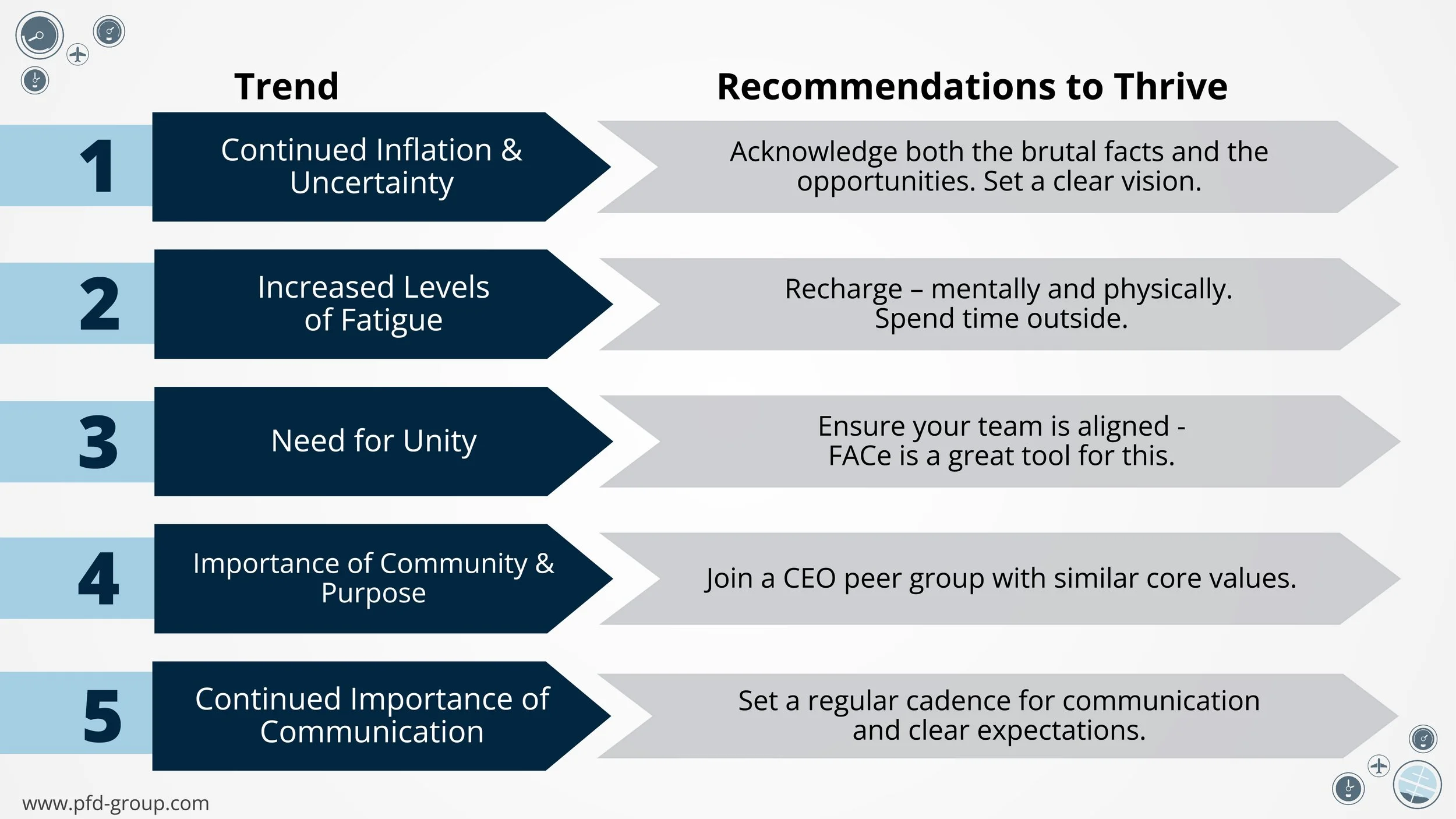
No doubt, the past two years have been incredibly difficult ones and just when we thought we might be turning a corner, the world has been cast into a new set of challenges that don’t appear to have any easy answers.
Despite the uncertainty, times of great challenge can also be times of great opportunity. Especially for those who are prepared. Ahead are five trends to be on the lookout for this year and recommendations on how you can thrive.
Trend: Continued Inflation and Uncertainty
For nearly two years, experts have been projecting “better times” ahead. Without a clear timeline for when that will unfold, and with the ongoing stressors being reported daily, it might be easy for leaders to lose faith in their forward momentum. Uncertainty, however, will always be a part of leadership planning. The antidote is to create a clear vision and stay true to its course. First, determine where you are going, then plug in the who and the how.
In times of great stress, we can take our lessons from Admiral James Stockdale, who was famously a prisoner of war during the Vietnam War. As the highest-ranking officer at the Prisoner of War Camp known as the “Hanoi Hilton,” Stockdale created a formula that could help his men survive even as they faced the most brutal conditions.
This formula, which has become known as the Stockdale Paradox, reads:
“Acknowledge and confront in every way the brutal facts of your situation and hold onto the unwavering faith that you will prevail in the end.”
In implementing the advice of Admiral Stockdale, leaders should not only face the realities of 2022 but also move forward with hopeful optimism that they will prevail through these circumstances. This is no small feat. Sometimes you have to dig deep to tap into your spirit of perseverance, but relying on your well-founded strategy and having a steadfast commitment to executing that strategy will help you stay the course.
Trend: Increased Levels of Fatigue
New global and local challenges also mean fatigue and stress will be a significant part of everyday life. As such, business leaders will feel the additional burden of how to take care of the people they employ as well as the people in their broader communities. As leaders, we often feel we need to put in extra hours to protect our team, but in doing so, we may forget to make time to take care of ourselves.
One easy fix is to spend time outside. It is called the GREAT outdoors for a reason.
The benefits of being outside have been regularly and scientifically documented and include reduced stress, reduced anxiety and depression, and a boosted immune system. While spending time outdoors won’t solve all your challenges, it can help you recharge and move forward with a stronger sense of purpose.
Simultaneously, encourage your team to spend time outdoors. By encouraging them to find ways to reduce their stress, you help foster a better workplace culture. If you are among the people who find it hard to make time for yourself, we encourage you to download our tool to schedule and protect your much-needed time to recharge.
Trend: Need for Unity
Speaking of workplace culture, 2022 is a time to bring people back together. After two years of remote work and Zoom meetings, the sense that we’re disconnected from one another will only continue to grow. To mitigate the sense of isolation, it is critical for leaders to build a sense of unity in their teams.
Unity can be forged by having the team in alignment as they refocus on the overall business strategy. To help build that unity, make sure to clearly define what each person is accountable for.
By utilizing a Function Accountability Chart (FACE), a tool developed by Verne Harnish in Scaling Up, leaders can create a Job Scorecard, where they highlight key roles in their organization, what competencies are most needed to fill those roles, and who is needed to fill missing roles
We recommend you fill out a FACE card during an in-person strategy session with your senior leadership. Define who will be responsible for what in three years’ time, making sure that every senior member is simplifying their functional role as much as possible. Then work backward – working through your BHAG, then your 1HAG, and then keeping backgward to your 90-Day Plan.
Clearly defining the vision can bring about a stronger sense of alignment towards the organization’s goals among the entire team.
Trend: Importance of Community and Purpose
As a CEO, you have already been hearing about “the great resignation,” as the economy is seeing unprecedented levels of people leaving long-standing jobs in favor of new opportunities. Keeping on track with your vision can help overcome this challenge to a certain extent.
However, “no man is an island” as the saying goes. Learning from your peers as to how they respond to challenges and successes can help you develop your own personal accountability. Cultivate your own personal leadership style by joining a peer group of similar business leaders. This group (also called a cohort or mastermind group) should consist of people who share similar experiences so you can help mentor one another.
It is imperative, however, to find a cohort that consists of people who have similar goals as you and who will support you in your challenges, just as you share their values and are ready to support them as well.
Trend: Continued Importance of Communication
Creating systems of accountability for your business is not enough to guarantee forward momentum. As anxiety and uncertainty prevail, it is critical that you give people impacted by your decisions a chance to voice their opinion.
When Monty Moran was Co-CEO of Chipotle, he made it a priority to visit as many restaurant locations as possible and talk to the people who worked at each location. He used those learnings to develop his own priorities. Monty then developed a managerial pipeline, creating better opportunities for employees to advance with Chipotle.
By having these conversations, Monty created programs that helped benefit his employees and fostered greater team unity.
We know 2022 may look daunting, but we’ve survived 2021 and 2020, and can continue to thrive as long as we stay true to our vision and find the right talent to work with us to build that vision. Stay the course, and the opportunities will present themselves.