
How shared goals and simple traditions can bring your people together.

How do we build a company where people feel connected to one another and excited about accomplishing something meaningful together?
I've been thinking about that question while coaching CEOs alongside Verne Harnish at his CEO Bootcamp in Vail this week.
After 15 years of coaching founders and CEOs, one thing I've learned is that building a great company is about much more than the financial results. Of course, results matter. We want to build healthy, profitable businesses that serve customers well and create opportunities for our employees and their families.
But I also think we have a wonderful opportunity to build companies where people enjoy working together, grow as leaders, and feel proud of what they're accomplishing.
That brings me back to the HP Way and how Bill Hewlett and Dave Packard approached building their company. They understood that relationships mattered, so they made time to get to know their employees, encouraged open conversations, and created simple traditions that brought people together.
What if we took some of those ideas and combined them with the discipline of Scaling Up?
What We Can Learn from the HP Way
Bill Hewlett and Dave Packard believed in treating people with respect, encouraging initiative, and giving employees opportunities to contribute ideas and take ownership of their work.
One of the practices associated with the HP Way was Management by Walking Around, where leaders made a point of spending time with employees rather than relying entirely on reports and formal meetings. They asked questions, listened, and stayed connected to what was happening throughout the company.
HP also became known for informal gatherings, including picnics and cookouts, that gave employees opportunities to get to know one another outside their usual responsibilities.
I think there's something really valuable in that approach, especially as companies grow and people become more focused on their own departments and responsibilities. The relationships that formed naturally when everyone worked closely together often require a little more intention as the business gets bigger.
And while those relationships are important, we also want to give people something meaningful and significant to accomplish together.
That's where I think one of the practices from Scaling Up can be especially helpful.
Give Your Team Something Worth Winning Together
One of my favorite practices from Verne Harnish's Scaling Up is the Quarterly Theme, which gives everyone in the organization a shared focus for the next 90 days.
Rather than having each department working toward its own priorities without much connection to the others, a Quarterly Theme gives people one important goal they can understand, contribute to, and celebrate together.
A good Quarterly Theme includes four elements:
A clear focus: What do we want to accomplish together this quarter?
A measurable goal: How will we know we're making progress?
A visible scoreboard: Can everyone see how we're doing?
A meaningful celebration: How will we recognize what the team accomplishes?
The goal might involve improving the customer experience, strengthening an operational process, or reaching an important milestone in the company's growth. What's important is that employees throughout the organization understand what they're working toward and how their individual contributions make a difference.
I particularly like the idea that someone who doesn't attend leadership meetings can still look at the scoreboard, understand how the company is doing, and feel proud of the progress they're helping make.
Now imagine combining that shared goal with a simple weekly tradition inspired by the HP Way.
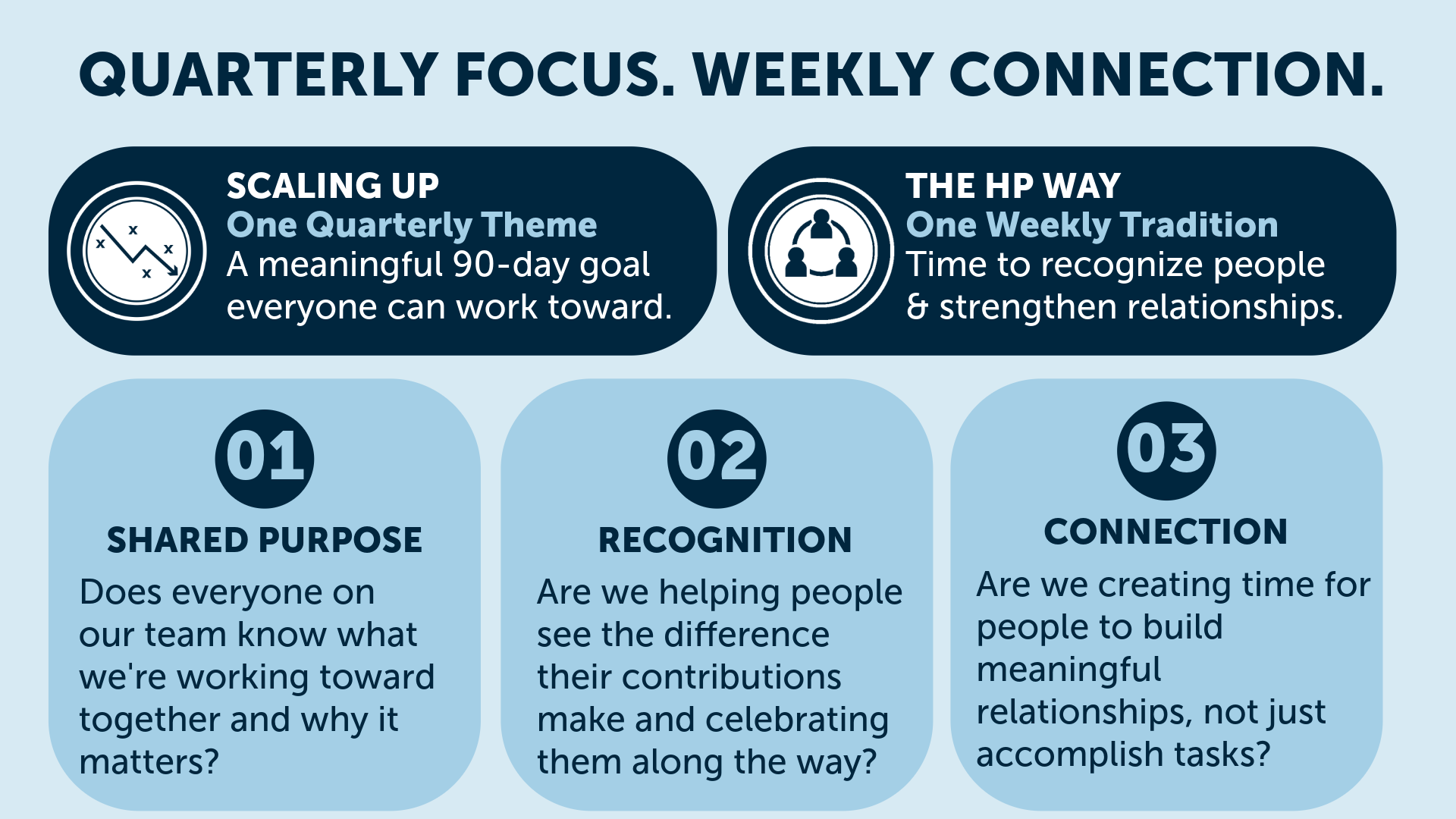
What if every Friday afternoon, you brought your team together for a little time to recognize progress and enjoy one another's company?
You might spend the first five minutes updating everyone on the Quarterly Theme, sharing how the company is doing and recognizing the progress made that week.
Then spend another five minutes celebrating employees who made a difference. Maybe someone went out of their way to help a customer, supported a colleague through a difficult situation, or came up with an idea that made everyone's work a little easier.
After that, put the agenda away, bring out some food, and give people time to visit and get to know one another.
It doesn't have to be a big production or an expensive event. The idea is simply to create a regular opportunity for people to celebrate what they're accomplishing and enjoy the relationships they're building along the way.
I think this is a great example of how we can lead with love and execute with rigor at the same time.
The Quarterly Theme gives everyone a clear goal and a way to measure progress, while the weekly gathering creates opportunities for appreciation, conversation, and connection.
If you decide to try something like this, I'd encourage you to keep it simple and make sure it works for your team.
And as the CEO, take advantage of that time yourself. Get to know employees you don't work with regularly, ask about their families, and listen to what's going on in their lives. Those conversations can be just as valuable as the updates on the scoreboard.