
INSIGHTS BLOG
Providing insightful, thought provoking
&
ultimately useful information
The Power of Margin
When I start working with high-growth founder CEOs, I often see a similar pattern.
Full calendars.
Decisions that never stop.
First in, last out.
It looks like commitment. But it’s actually a warning sign.
From the outside, the business may look healthy. Revenue is growing. The team is busy. On paper, things still look successful.
But internally, something starts to shift.
Decision-making flows upward. Leaders wait instead of owning. Important conversations get delayed because everything still runs through one person.
The team is capable. But over time, the business becomes increasingly dependent on one leader to keep everything moving.
Being busy is not a badge of honor.
The CEO has slowly become the ceiling.
That’s what a lack of margin often looks like.
What margin actually creates
Margin is the space between your next commitment and your capacity to think clearly.
It’s not a luxury.
It’s what allows leaders to stay strategic, develop leaders around them, and lead from clarity instead of constant reaction.
What the best leaders protect
The healthiest leaders I know protect their margin.
Space to think.
Space to reflect.
Space to develop the people around them.
Space to develop the business.
The best thinking doesn’t happen in back-to-back meetings.
It happens on a walk. During quiet thinking time. In quality conversations that aren't rushed.
For me, it often comes through a committed morning routine, yoga, flying, time in nature, travel, and quality time with family and friends. I’m also privileged to lead a team that steps into leadership to better serve our clients.
Where to start
Margin has to be built intentionally.
Start small. Ninety minutes a week. One block protected on the calendar.
But for many CEOs, the deeper issue is not just the calendar.
It’s that too many decisions still flow back to the CEO.
Over time, that creates a business where leaders wait instead of owning and the CEO becomes the bottleneck for clarity, direction, and decision-making.
The Function Accountability Chart is one of the first tools I use when I start working with leadership teams. When ownership becomes clear, leadership teams stop reacting and start leading together.
Where does your clearest thinking happen, and how much of your week is actually designed around it?
Does every person on your leadership team know exactly what winning looks like in their seat?
Your business needs the best of you. And so does everyone else in your life.
The One Conversation Most Leadership Teams Have Never Had
One of the most transformational moments in scaling a company happens when a leadership team stops operating on assumptions and starts operating with clarity.
The Function Accountability Chart is far more than an org chart. It is a leadership alignment tool that defines who is accountable for each critical function of the business and, more importantly, the outcomes that define success in that role.
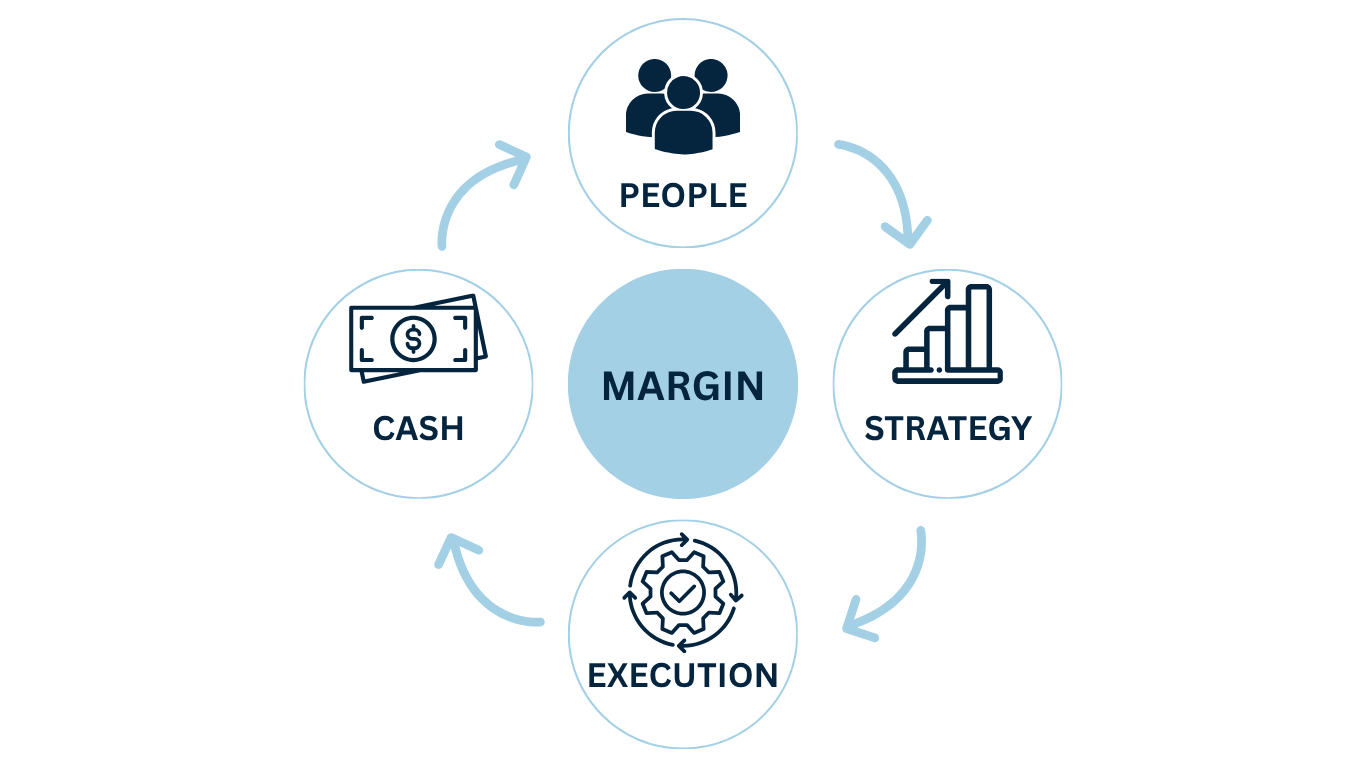
When senior leaders openly clarify ownership around people, strategy, execution, cash, customer experience, and operational excellence, confusion begins to disappear.
Silos break down. Trust increases because expectations are no longer hidden or implied. The leadership team gains the confidence to challenge, support, and collaborate at a higher level because everyone knows who owns what.
In healthy scaling organizations, leaders stop protecting territory and start building together as one team.
What gets in the way?
Lack of clarity.
Excuses instead of accountability.
And often, a misunderstanding of what actually creates value within each function of the business.
But here’s what I see in practice.
Most leadership teams have the right people. But when I ask what winning looks like in their seat this quarter, the room goes quiet.
Most leaders know what their team does. Fewer know the outcomes they are accountable for driving.
Without that clarity, the default becomes activity. People stay busy. Meetings happen. Projects move. But over time, capable leaders stop driving and start reacting.
Marketing blames sales. Sales blames operations. Leaders start protecting functions instead of building together as one team.
That’s what unclear ownership produces.
This is why the Function Accountability Chart matters so much. It creates clarity around ownership and outcomes.
How to build one
List every function on your leadership team. Sales, Marketing, Operations, Finance, HR, and any others specific to your business.
For each function, assign one name. Not a team. One person.
Then for each seat, answer two questions: What outcomes is this function responsible for driving? What metrics validate success?
Once it’s built, ask four questions:
Is there more than one person in this seat?
Is one person stretched across too many seats?
Are there empty seats nobody owns?
Would you enthusiastically rehire the person for that role?
That last question is the one most leaders avoid. It’s also the most important.
Because now the conversation is no longer about activity. It’s about whether the business can scale beyond the CEO.
Does every person on your leadership team know exactly what success looks like in their seat this quarter?
Or are people still operating on assumptions?
If you’re ready to build this with your team, I’d love to be in the room. The FAC is one of the first tools I use with every leadership team I work with. Reach out and let’s build it together.
The Hedgehog Concept: Simplifying Strategy for Lasting Impact
With every season of growth comes a wave of new opportunities. The key is knowing which ones truly align with your mission.
Jim Collins’ Hedgehog Concept, first introduced in Good to Great, offers a timeless, clarifying framework. Inspired by an old Greek parable—“The fox knows many things, but the hedgehog knows one big thing”—rather than chasing every opportunity, this concept helps leaders to build with intention.
While the fox dashes from tactic to tactic, the hedgehog survives and thrives by doing one thing exceptionally well: rolling into a ball of spikes no predator wants to challenge.

The Three Questions That Define Strategic Clarity
For leaders committed to building organizations that last, Collins poses three questions that guide your “hedgehog” focus:
What can you be the best in the world at?
Not just what you’re good at—but where you can lead your industry with unmistakable authority.What drives your economic engine?
The key financial metric or model that fuels your organization’s long-term sustainability and scale.What are you deeply passionate about?
The work that stirs your soul—the mission that energizes your team and aligns with the legacy you’re building.
Where these three circles overlap, you find your Hedgehog Concept: the core of your strategy, the heart of your identity, and the engine of enduring impact.
Focus is a Leadership Advantage
We often remind our clients that the most successful leaders build from a place of clarity. The Hedgehog Concept isn’t just a strategy tool—it’s a mindset. One that helps you simplify complexity, align your team, and accelerate toward your vision with conviction.
As your organization continues to scale, revisit your Hedgehog. Make the choice to focus. And trust that doing so will bring both short-term momentum and long-term legacy.